To be honest, I don't even remember how it all started. Sometime in 2017, when I was about ten years old, I first caught myself thinking: "But I don't just want to play on the computer, I want to understand how it works." That was the first time I heard the word Python — everyone said it was a simple language for beginners. Well, if it's simple, then you have to try. I searched for tutorials, watched videos, copied examples, and felt I feel like a real hacker, even if my code was just outputting «Hello, world!».
And so, along with my interest in Python, another thing came into my life. the word is Linux. On the forums and in the videos, everyone said, "If you want to become a real programmer, install Linux." It sounded scary. Terminal, commands, obscure words like distribution, the repository, GRUB... But curiosity got the better of him. I wanted to understand why people admire this system so much. Is that really it Is it really something special?
My first installation is Ubuntu in a virtual machine. I turned it on YouTube, opened the tutorial and followed the author step by step., afraid to press the wrong button. When the desktop appeared on the screen GNOME, I just sat and watched — everything looked different. Not like Windows, not like usual. It was some kind of new territory. Everything was strange, but there was a special magic in it. And yes, when I opened the terminal and saw the blinking cursor on black In the background, it got a little creepy. But that's when my getting to know the system, which later became a part of life.
I wrote my first Hello, world!, played around with the commands, I installed a couple of packages, I was glad that something was working at all "and... abandoned it." Then school, games, and everyday life were taken away again. I'm from Linux. But the residue remained —that very feeling of something. another, free one, where you choose how everything works.
From habit to love
Several years have passed. 2020 has arrived, a move, a new life, new habits. And then, somewhere in the confusion, I remembered again. about Linux. This time it's Fedora. I decided that if I was going to do it, then for real: installed next to Windows, crashed the disk, almost everything I ruined it, but I saved the situation with the help of one kind person from Telegram. Fedora came to life, and I booted into the system for the first time., installed "for real", and not in a virtual machine. It was mine. the first step into a real, not a sandbox environment.
GNOME greeted me with its laconic look again, but now I I looked at him differently. I learned from my mistakes, I read I wrote documentation, wrote scripts, changed themes, and fiddled with settings. For the first time, I realized that Linux is not a toy, but a tool. He stopped being something incomprehensible and became a space for experiments.
Then the classics began: distributions replaced each other. Arch, Void, Slackware, openSUSE, Debian, and many more minor distros — everyone is interesting in their own way, with their own character and philosophy. Arch was like a survival course: you do everything yourself, you understand everything, but then you get proud. Void — fast, minimalistic, almost ascetic. Slackware is an old, reliable, real old school, where everything is based on understanding and respect for traditions. openSUSE — strict and precise, with German precision. Debian — stable, calm, like an old friend who will never let you down. Each The distribution added something new to my understanding of the system and to my experience. You could say that I started having a real dystrohoping is a constant search for the perfect assembly, in which I wanted to try everything. It was like traveling through to the Linux continent: new shells, package managers, configs — everything beckoned and wouldn't let me stop.
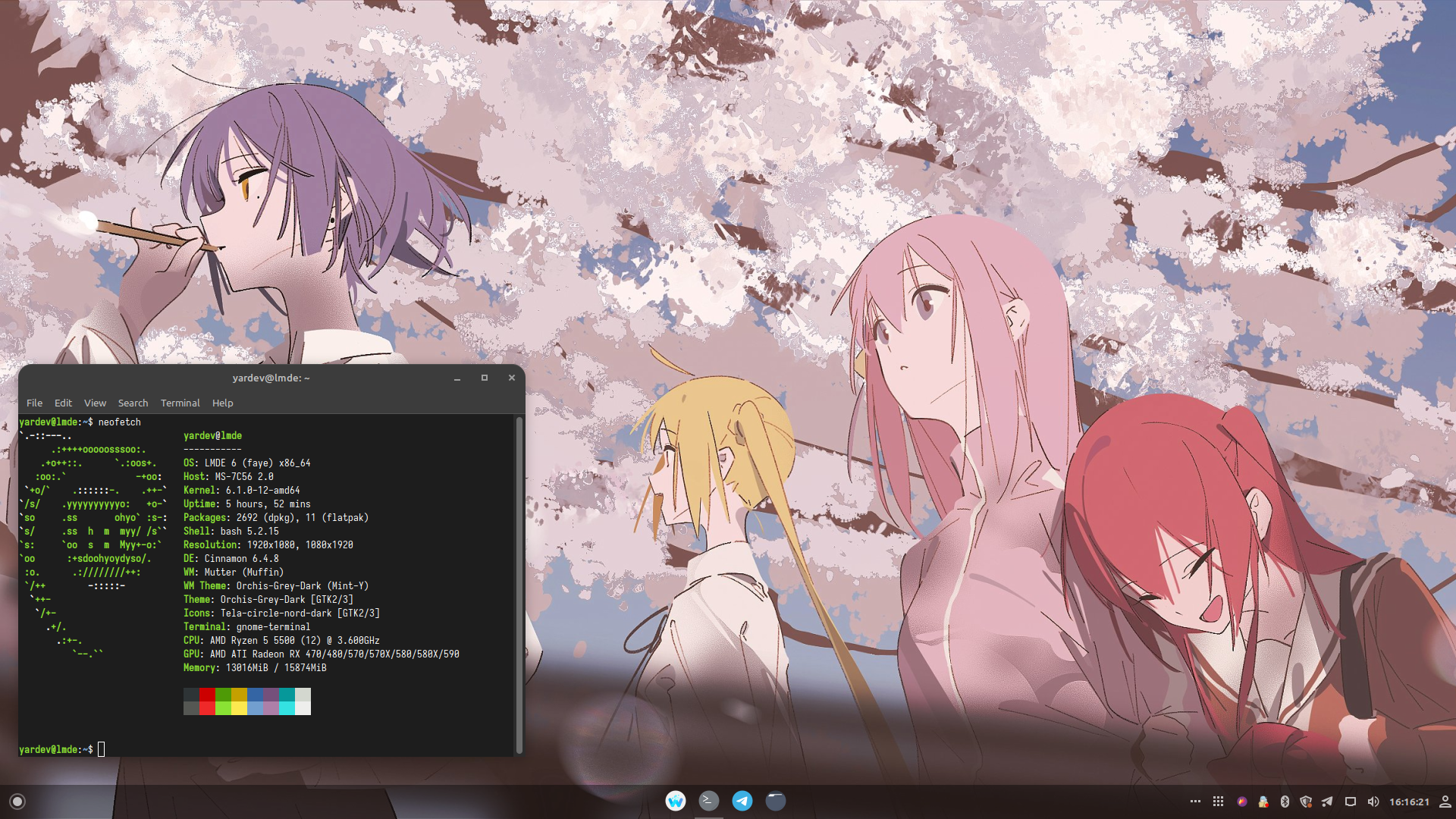
In the process of these experiments, I began to understand what I want from your own system: simplicity, stability, and all the possibilities customize it for yourself, but without the endless "dancing with a tambourine". After after a lot of trial and error, I finally settled on Debian, or rather, on its fork LMDE (Linux Mint Debian Edition). This, perhaps that's the balance I was looking for: Debian reliability, Mint's neatness and visual comfort, as well as the confidence that everything will work without surprises. With LMDE, I felt for the first time real peace of mind is when the system does not interfere, but helps.
Right now, my Linux looks the way I've always wanted it to: lightweight the interface, its own scripts for everyday tasks, automation, a neat terminal with transparency and fonts that are pleasing eye. When I turn on my computer, I know everything is under control. No annoying updates, unnecessary software, and imposed solutions. This my system, and only I decide how it should work.
Why won't I go back to Windows
Technically, I could, but emotionally, not anymore. After Linux Windows seems like a closed box where they give you something ready-made. Environment and say: "Don't touch it, it's necessary." Everything looks like It's beautiful, but there's no air in it. In Linux, everything is different: do you want to Change your appearance? You are welcome. Do you want to assemble a core for yourself? For God's sake. Do you want to delete half of the system and do everything through Terminal — who's going to forbid you? This is freedom, which is fast approaching. You get used to it.
And it's not even about the interface or the packages — it's about the feel. The terminal has become not just a tool for me, but almost a language. thinking. When you open it and write a couple of commands to Solve the problem, you feel in control. Do you understand that you don't You just use the system, you talk to it like you're talking to an equal. And this dialogue forms a special relationship with the computer.: you don't consume, you create.
Besides, Linux has instilled patience in me. When the system does not it starts, but there is only an error line on the screen — this is not the end, this is a challenge. You sit down, read the logs, look for a solution, find out something new. And then, when everything works, you feel real pride. Because you didn't just "tick the box" — you figured it out.
The Linux Philosophy
Over the years, I've realized that Linux is not about an "OS." It's about approach. About the ability to dig, read, search, and not be afraid of mistakes. It's about taking responsibility for what works for you. (or it doesn't work). It is a culture of independence and respect for the work of other people.
Open source teaches respect for tools. When you see how everything is arranged from the inside, there is gratitude — because someone invested the time to make it accessible. There is no "it" in Linux. by itself." It's just you and the system. If something is wrong, you go and You're figuring it out. Sometimes for a long time, sometimes with mistakes, but in the end — with understanding. This feeling of understanding is the real reward.
Linux has made me more patient, more attentive, and more confident. He taught me value transparency and freedom of choice. After all, this is its essence — not just "do as you want", but "understand why you are doing it." That's right." There is no place for randomness here: every action Consciously, every setting makes sense. It is a philosophy that It penetrates far beyond the computer — into work, projects, and life in general.
Conclusion
My path is from the first "Hello, world!" in Ubuntu to a stable one LMDE environments on a desktop PC are not just a story about choice "the best system." It's a coming-of-age story. The story of how The fear of the terminal has become a habit of opening it first thing in the morning. How understanding grew out of curiosity, and out of Experimentation is confidence.
Linux has become more than a tool for me. He became a part of a way of thinking, working, and learning. He taught me Don't be afraid of complexity, look for solutions, respect openness and share experiences. He has a freedom that others lack. And honesty is the one that makes you look inside and investigate.
And, perhaps most importantly, with every distribution, with every It was a mistake, and with each victory, I understood a little better not only the system, but also yourself. Today, opening the terminal and seeing a familiar The $ string, I don't feel fear or confusion, but confidence. and peace of mind. It's more than an operating system — it's a part of my story.
And perhaps this post is not just a story about my journey. This a small challenge to you: if you are reading these lines and even a little if you feel interested, try it yourself. Install Linux, play around with With the terminal, look at how everything works. Perhaps it started with this Your story will begin.